How to create a travel agency website: a step-by-step guide

- What a travel agency website should include
- Step 1: Prepare your content before building the website
- Step 2: Choose a website builder
- Step 3: Choose a travel agency template
- Step 4: Add content to your website
- Add your main travel offer
- Add an inquiry form
- Add customer reviews
- Add tours and travel packages
- Highlight your agency’s advantages
- Make it easy to contact your agency
- Step 5: Create additional pages for your travel business
- Step 6: Customize the website design
- Step 7: Publish your travel agency website
- The bottom line
- FAQ
- How much does it cost to create a travel agency website?
- Can I connect my travel agency’s existing domain to Taplink?
- Can I update content after publishing the website?
- Can I track visitors on my travel website?
- Can I manage leads from my travel website?
- Can I create a multilingual travel agency website?
- Can I add a QR code for my travel agency website?
Before you build a travel website, decide what visitors need to see and do. A travel agency website doesn’t need dozens of pages. It needs clear information and an easy way to request or book a trip.
A basic travel agency website should include:
- A clear description of your travel services.
- Featured tours or vacation packages.
- Prices or starting prices.
- A contact or inquiry form.
- Customer reviews.
- Your contact details and business location.
- A clear call to action.
- Information about your experience and support.
The exact structure depends on your business model. A travel advisor who creates custom trips needs a different site from an agency that sells ready-made vacation packages.
For example, a travel agency that creates personalized vacations can focus on customer preferences and trip planning. An agency that sells ready-made vacation packages can focus on destinations, prices, and booking details.
You can create your travel website faster when you prepare the main information first.
Start with these elements:
- Agency name and logo.
- Short description of your services.
- Main travel offer.
- Tour or package information.
- Prices or starting prices.
- Customer reviews.
- Contact details.
- Business hours.
- Location if applicable.
- Inquiry or booking information.
Prepare your travel photos at the same time. Use images that show the destinations, hotels, activities, or experiences you sell.
Your offer should also include specific information. For example, a package can show the destination, number of nights, price, meal plan, and departure date.
A website builder lets you create a travel agency website without handling its technical setup yourself.
Taplink is a mobile website builder for businesses, creators, and service providers. It lets you create a mobile-first website with images, videos, forms, price lists, a map, and other content blocks.
Taplink is suitable for travel agencies that need to present their services, promote vacation packages, collect inquiries, and provide contact information in one place. You can also use it to accept payments for eligible products and services.
You can create a website in three ways:
- Start with a template.
- Use the AI builder.
- Build the page from scratch.
Templates already have a ready-made website structure, sample content, and design. You only need to replace the existing content with your own. The AI builder can generate the initial page from a description of your business in about 10 seconds.
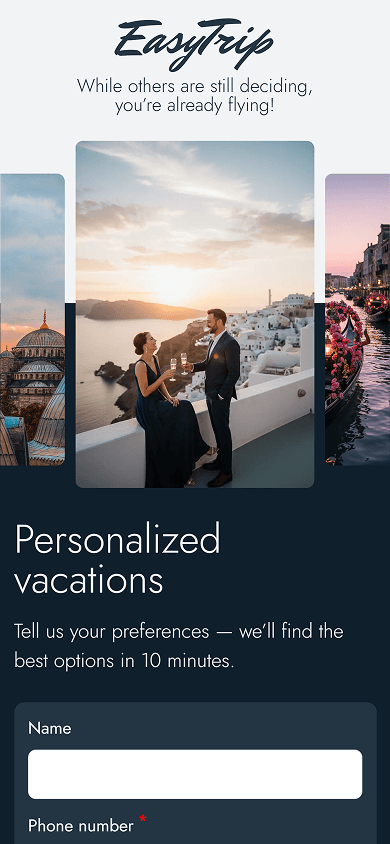
To make the process easier to follow, we’ll use the EasyTrip website as an example. It was created in Taplink from a template.

To select a template, create an account in Taplink.
Taplink has over 100 templates, including templates for travel agencies, tour planners, and travel-related businesses. These templates already contain sections that you can adapt to your services.

If you like the travel website shown above, use this travel website template. To choose another template, visit the Taplink template library.
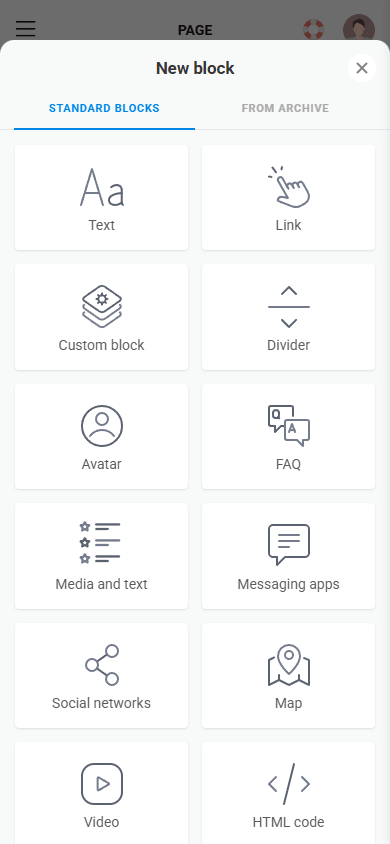
After choosing a template, you’ll see that it comes with ready-made content. Your next step is to adapt it to your business. The content is organized into blocks. You can edit the blocks that are already there or add new ones. Taplink has 20+ blocks available:

In this step, we’ll cover what to add to your travel agency website and share tips for each section. We’ll also show how these ideas can look on the EasyTrip website.
These tips apply whether you create your website with a template or AI.
For detailed instructions on creating a Taplink website, see these guides:
The first section should explain what you sell.
Avoid using a generic headline such as “Your Travel Agency.” State the actual offer instead.
EasyTrip uses “Personalized vacations” as its main offer. The description explains that visitors can share their preferences and receive suitable options within 10 minutes.

This approach works because visitors immediately understand:
- What the agency offers.
- That trips are selected based on their preferences.
- How quickly the agency responds.
- What they need to do next.
Use the same principle when you create a tourism website. Put the most important information near the top instead of hiding it behind several sections.
A travel agency often needs customer details before it can recommend a package.
Taplink lets you add a form to collect this information. You can choose the fields that match your sales process.
In our example website, the form asks for five responses.

You can adjust the fields to your sales process. For example, you can ask about:
- The number of travelers.
- Budget.
- Preferred hotel category.
- The places a client wants to visit.
You can also ask for any other information you need to create a personalized trip.
When a visitor submits the form, the inquiry is automatically saved in Taplink CRM. This gives you one place to manage potential customers instead of tracking requests across chats, emails, or spreadsheets.
In the CRM, you can view contact details, check when a person submitted a request, and update the client statuses to follow the progress of each inquiry. This helps you see which requests are new, which customers have been contacted, and which inquiries are ready to become bookings.
If several people handle customer inquiries, you can give them team access to your travel website. Team members can help manage the site and work with CRM data, so everyone can keep track of customer requests in one place.
Travel purchases involve more than price. Visitors also want to know whether other people have had a positive experience with the agency.
EasyTrip places three customer reviews after the main offer. Together, they show that the agency helps customers choose suitable destinations, consider their preferences, and provides support during the trip.

Avoid using several reviews that make the same point. Choose testimonials that show different parts of your service instead. This helps visitors understand what they can expect from your agency.
Reviews are especially useful when you build a travel agency website for a new brand. They give visitors evidence that other people have used your services. Keep each review short and specific so visitors can quickly understand what customers value about your agency.
If you sell ready-made tours, showcase them.
Taplink supports several content blocks for presenting your offers, including images, videos, price lists, and pricing plans.
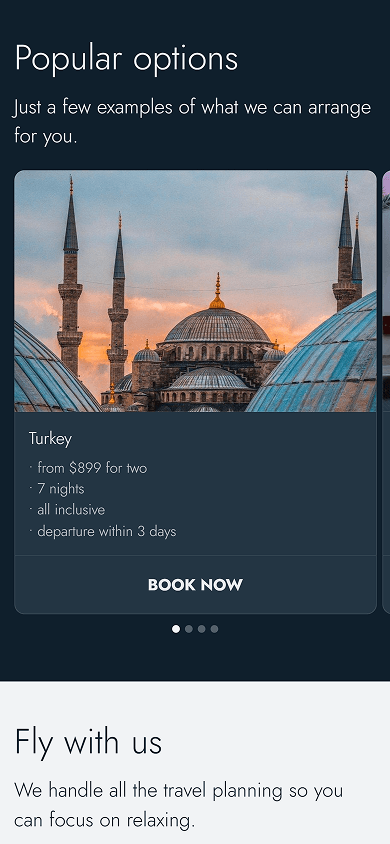
EasyTrip uses an image carousel for its “Popular options” section. It shows four destinations with starting prices, trip duration, and departure information.

You can choose other blocks based on your content. Here are a few examples of use cases:
- Use Image and Image carousel blocks when destinations are the main selling point.
- Use the Video block to show hotels or travel experiences.
- Use Pricing plans when visitors need to compare several packages.
Keep package descriptions short. Travelers should be able to compare several offers without reading long paragraphs.
Add a section that shows what makes your travel agency worth choosing.
EasyTrip uses the “Fly with us” section for this purpose. It combines a short customer-focused statement with several specific advantages, such as 24/7 support, fast response, 3500+ clients, and 8+ years of experience.

When creating this section:
- Focus on benefits that matter to travelers, such as support, experience, or fast responses.
- Use specific numbers when possible. “8+ years” is more convincing than “extensive experience.”
- Keep each advantage short so visitors can scan the section quickly.
- Choose benefits that distinguish your agency from competitors.
Your website should make it simple to contact your travel agency. Add your phone number, email address, messaging apps, business hours, and physical address when relevant.
EasyTrip places its address, map, and opening hours near the bottom of the page. It also uses a contact button as its CTA.

You can use a CTA contact button, too. Choose one main action for visitors to take after learning about your services.
You can use a CTA that matches your sales process:
| Goal | Primary CTA |
| Custom travel planning | Request a trip |
| Tour sales | Book a tour |
| Travel consultation | Schedule a consultation |
| Personalized vacations | Find my vacation |
| General inquiries | Contact us |
Place the primary CTA in several relevant sections. This gives visitors an easy next step without making them scroll back to the top.
You can also keep other contact methods available for visitors who prefer to call, email, or message you.
If your agency serves a specific area, include the city and service area in your website copy. This gives local customers useful context and supports local search.
A single-page website can be enough for a small agency. Larger businesses may need additional pages.
Taplink supports multiple subpages, so you can separate different types of content when needed. For example, you can create the following types of pages:
- Home.
- Tours.
- Destinations.
- About the agency.
- Travel insurance.
- Contact.
A separate page can also work for specific campaigns or destinations. For example, a Turkey travel campaign can have its own page with packages, prices, photos, and an inquiry form. The same applies to the rest of the destinations.
This approach gives you more flexibility while keeping the homepage focused.
After adding your content, adjust the visual style to match your agency.
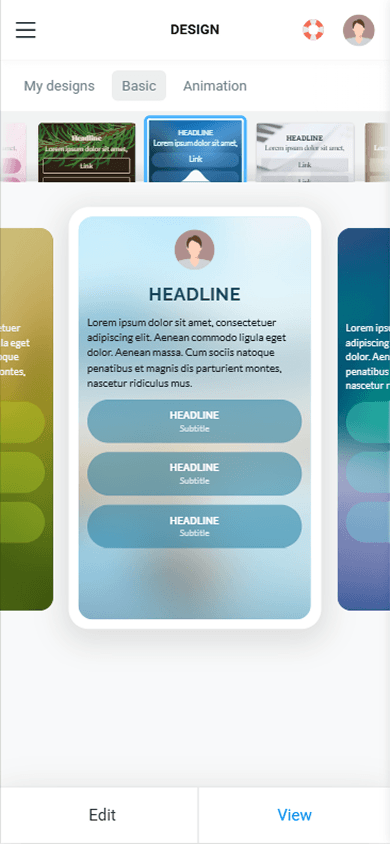
Taplink offers three ways to customize your website: themes, basic settings, and advanced settings.
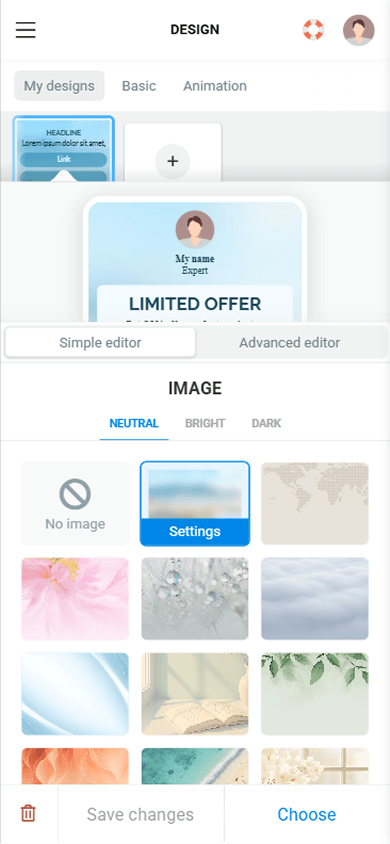

For a travel agency website, pay particular attention to:
- Brand colors: Choose colors that work well with your travel photos and keep them consistent across the page.
- Button visibility: Make your main CTA buttons easy to spot against the background.
- Text readability: Use enough contrast between text and the background, especially over images.
Don’t add too many different colors or fonts. A simple visual system helps visitors focus on your travel offers and main CTA.
Once the content and design are ready, publish your website.
Taplink gives you a Taplink web address. You can also connect a custom domain with the Business plan.
A custom domain is useful for an established agency. Use a domain that matches your brand name and is easy to remember.
Before publishing, check every button and form. Make sure phone numbers, addresses, prices, and package details are correct.
A travel agency website should showcase your offers, build trust, and make it easy to contact your agency. A simple structure helps visitors find important information and take the next step.
Taplink lets you quickly create a mobile-first website with a template, the AI builder, or from scratch. Templates are a good starting point because they provide a ready-made structure that you can adapt to your agency.
Regardless of the creation method, keep your main offer clear, use real reviews and destination photos, and make your main CTA easy to find.
You can create a travel agency website with Taplink starting with the free plan. Paid plans cost $4/month and $8/month when billed annually. The final cost also includes a custom domain, subpages, built-in CRM, and other features.
Yes. Taplink’s Business plan lets you connect a custom domain to your page.
Yes. You can edit your Taplink page after publishing. This lets you update information about your agency, prices, destinations, package details, and other content without creating a new website.
Yes. Taplink analytics shows website activity, including views, clicks, conversions, devices, and locations. You can use this data to see how visitors interact with your website.
Yes. Taplink stores information submitted through forms in the Leads section. You can view lead details, choose which information to display, filter leads, change their statuses, process multiple leads at once, and export lead data as a CSV file.
You can create a separate subpage for each language and add buttons for these languages to your homepage. Visitors can choose their preferred language and go directly to the matching subpage.
Yes. Taplink automatically generates a QR code for your page. You can use it on printed materials, business cards, brochures, or other offline marketing materials.